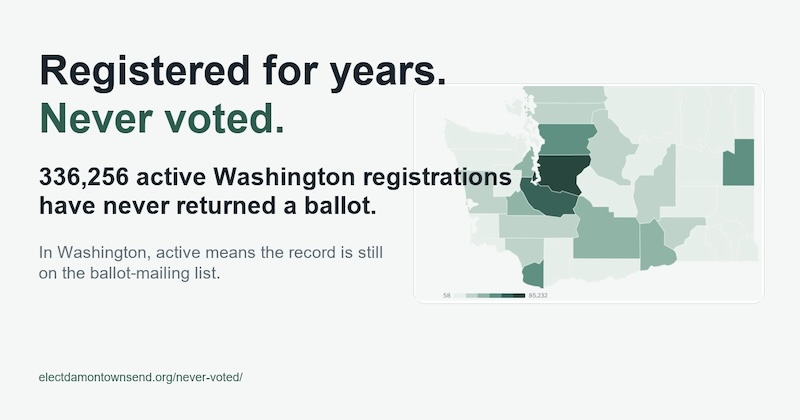
Registered for years, 336,256 active Washington registrations have never voted
Washington needs voter roll maintenance, not voter roll theater.
Check out my Never Voted Dashboard for graphics.
Washington currently maintains over 336,000 active voter registrations that have never cast a ballot, presenting an opportunity for practical voter-roll maintenance that saves taxpayer money and protects voter rights.
Washington uses the word “active” in a way that does not mean what most people think it means.
To most people, an active voter is someone who votes, or at least votes once in a while. In Washington’s election system, that is not what active means. An active registration is a record that is eligible to receive a ballot. If the record is active, the county mails a ballot to it.
That is the key point. Active does not mean the person is participating. Active means the registration is still on the ballot-mailing list.
That is how we end up with 336,256 active Washington registrations created before 2024 that have never voted in the available records. These are real people in the voter-registration system. They are registered to vote. Counties mail ballots to them because their registrations are active. But according to the available records, they have never returned a ballot.
Most people would hear that and say, “Wait, if they have never voted, why are they active?” That is exactly the question.
The answer is that “inactive” is also a legal term, not a common-sense description. Inactive does not simply mean “doesn’t vote.” Inactive status is usually connected to address verification and voter-roll maintenance rules. An inactive voter has not lost the right to vote. Washington law allows an inactive voter to be restored to active status by voting, updating their address, or otherwise confirming eligibility. The point of inactive status is not punishment. It is keeping the active ballot-mailing list accurate.
Once people understand those definitions, the problem becomes much clearer. Washington has hundreds of thousands of registrations that are active in the legal and administrative sense, but inactive in the ordinary sense. They keep receiving ballots, keep costing money, and keep affecting turnout numbers, even though they have never voted in the available records.
That should concern anyone who cares about elections. It does not mean these voters did anything wrong. It does not mean every record is invalid. It does not mean anyone should be removed without notice. But it does mean we have a real voter-roll maintenance problem that deserves a practical answer.
I am not talking about someone who skipped a special election. Normal people do that. Voters do that. Nonvoters do that. Things happen. People miss a local race, a February special, a levy election, or a primary where nothing catches their attention. That is not unusual, and that is not the problem I am describing.
This file is different. It shows 336,256 active Washington registrations created before 2024 that have never voted in the available records. These are active registrations that have been on the rolls for years, in many cases election after election, without a single recorded ballot return. A normal low-propensity voter may vote once every few years, skip local races, or vote only when an issue matters. But a registration that receives ballots for years and never returns one raises a different question: is this registration still current?
That is the administrative problem. Washington’s vote-by-mail system depends on the active voter list. If a stale, abandoned, incorrect, or unused registration stays active, the county keeps mailing ballots to it. Printing the ballot packet costs money. Preparing it costs money. Mailing it costs money. Tracking it costs money. Handling returned mail costs money. Keeping bad records in the system costs money. This is not just a database issue. It is a taxpayer issue, a workload issue, a turnout-measurement issue, and a public-confidence issue.
I reviewed this data because I have worked as a professional elections administrator. That experience changes how I look at this issue. I do not start with a conspiracy theory. I start with the file, the process, the cost, and the maintenance question.
I published the dashboard so people can check the numbers themselves:.
The dashboard lets readers look statewide or county by county, including Pierce County, and see how these records affect turnout calculations. It also includes an exception report, which is important because not every record means the same thing. Some records look like possible data-quality problems, some may be older records where history did not migrate cleanly, some may point to voters who should be verified, and some are young pre-registered voters who should be treated differently. This is not a purge list. It is a maintenance map.
This is where my Cascade Party perspective and my election-administration experience meet. Cascade is a solutions-based party. We do not need to win arguments by pretending problems are bigger than they are, and we do not need to avoid problems because the politics are uncomfortable. We should look directly at what is happening, explain it plainly, and offer a practical fix that protects voters and respects taxpayers.
This issue has practical solutions. Washington should not remove eligible voters without notice, and Washington should not keep mailing ballots forever to registrations that never respond. Those are both reasonable positions. The fix is a verification process: after years of no ballot returns and no voter activity, send a confirmation notice. If the voter responds, updates an address, or votes, keep the registration active. If the voter does nothing after notice and through the required legal period, stop treating that record as an active ballot-mailing record.
That kind of policy protects voter rights and voter-roll integrity at the same time. Eligible voters stay protected. Mistakes remain easy to fix. Counties get a lawful way to clean up stale active records. Taxpayers stop paying indefinitely for ballot packets that never come back. And turnout numbers become more honest because the denominator is not padded with records that never participate.
There are other practical improvements that should go with it. Counties should have clear reporting on how many active records are being verified, how many are moved to inactive status, how many are restored, and how many are eventually canceled after the legal waiting period. The public should be able to see that this is a maintenance process, not a purge. Washington should also make the confirmation notice simple, readable, and easy to respond to, because the goal is to verify voters, not trap them.
Washington does not need to invent this from scratch. Ohio already uses a process that has been legally tested. Ohio’s Supplemental Process was challenged all the way to the United States Supreme Court in Husted v. A. Philip Randolph Institute , and the Court upheld it because Ohio was not simply canceling people for failing to vote. Failure to vote was not the final reason for removal. It was the trigger for a confirmation process.
That distinction matters. Under Ohio’s approach, a voter registration that shows no voter activity can be sent a confirmation notice. If the voter responds, updates the registration, or votes, the registration is preserved. If the voter does nothing after notice and then has no voter activity through the required federal-election period, the record can eventually be canceled. That is the kind of system Washington should study: not “you did not vote, so you are gone,” but “you have received ballots for years and never returned one; please confirm that this registration is still current.”
Washington also has a stronger voter-access safety valve today than it used to have. We now have same-day in-person registration and address updates all the way until 8:00 p.m. on Election Day. If an eligible voter is moved to inactive status by mistake, that voter still has a path to correct the record and vote. That does not mean election offices should be careless. It means we can protect voters and maintain the rolls at the same time.
The cost side matters too. A ballot packet is not free. Even if we use a modest estimate of $2 to $4 per packet, mailing one ballot to each of these 336,256 never-voted registrations costs somewhere between about $670,000 and $1.35 million statewide. Do that for a primary and a general election, and the cost is roughly $1.3 million to $2.7 million before we even talk about special elections, returned mail, replacement handling, or staff time.
Pierce County shows the same problem closer to home. Pierce has 45,613 active registrations in this file. At $2 to $4 per packet, one mailing to those records costs roughly $90,000 to $180,000. For a primary and general election, that is roughly $180,000 to $365,000 in Pierce County alone. That is real public money being spent to mail ballots to registrations that, according to the available records, have never voted.
The turnout point is just as important, and it is simple. Turnout is a fraction: ballots counted on top, registered voters on the bottom. If the bottom number is inflated with thousands of registrations that never vote, the turnout percentage goes down. The community looks less engaged than it really is.
That matters because low turnout can become a self-fulfilling prophecy. When voters constantly hear that “nobody votes,” participation starts to feel abnormal. People assume their neighbors are checked out, that civic involvement is pointless, and that staying home is what everyone else is doing. Accurate rolls will not make people vote by themselves, but they do give the public a more honest signal about participation.
Pierce County has a turnout problem, and I am not trying to explain that away. We need more people voting. But the denominator matters. In the August 2026 primary, Pierce turnout was 30.4%. If these never-voted active registrations were removed from the active-registration denominator, Pierce turnout would be 32.9%. In the November 2025 general election, Pierce moves from 33.9% to 36.7%. That does not solve turnout, but it shows why the voter-roll denominator matters.
Washington should consider a practical reform: after years of no ballot returns and no voter activity, send a confirmation notice. Give the voter every reasonable chance to confirm, update, or vote. Keep every eligible voter protected. But if a record never responds, never updates, and never votes through the legal period, stop mailing ballots to it as an active registration. That approach protects voter access, saves taxpayer money, improves turnout reporting, and strengthens confidence in the voter roll.
This is voter integrity, but it is also government efficiency. Protect every eligible voter, make mistakes easy to fix, stop wasting public money on records that never respond, and use a legally tested verification process. That is the kind of election reform Washington should be willing to discuss.
Sources and data:
- Interactive dashboard:
- Washington same-day registration:
- RCW 29A.08.130:
- Husted v. A. Philip Randolph Institute: Husted v. A. Philip Randolph Institute:
- Ohio Supplemental Process explanation:
MORE SUMMIT
Damon Townsend for Pierce County Auditor Website.