Redemption at the Olympia Money Machine
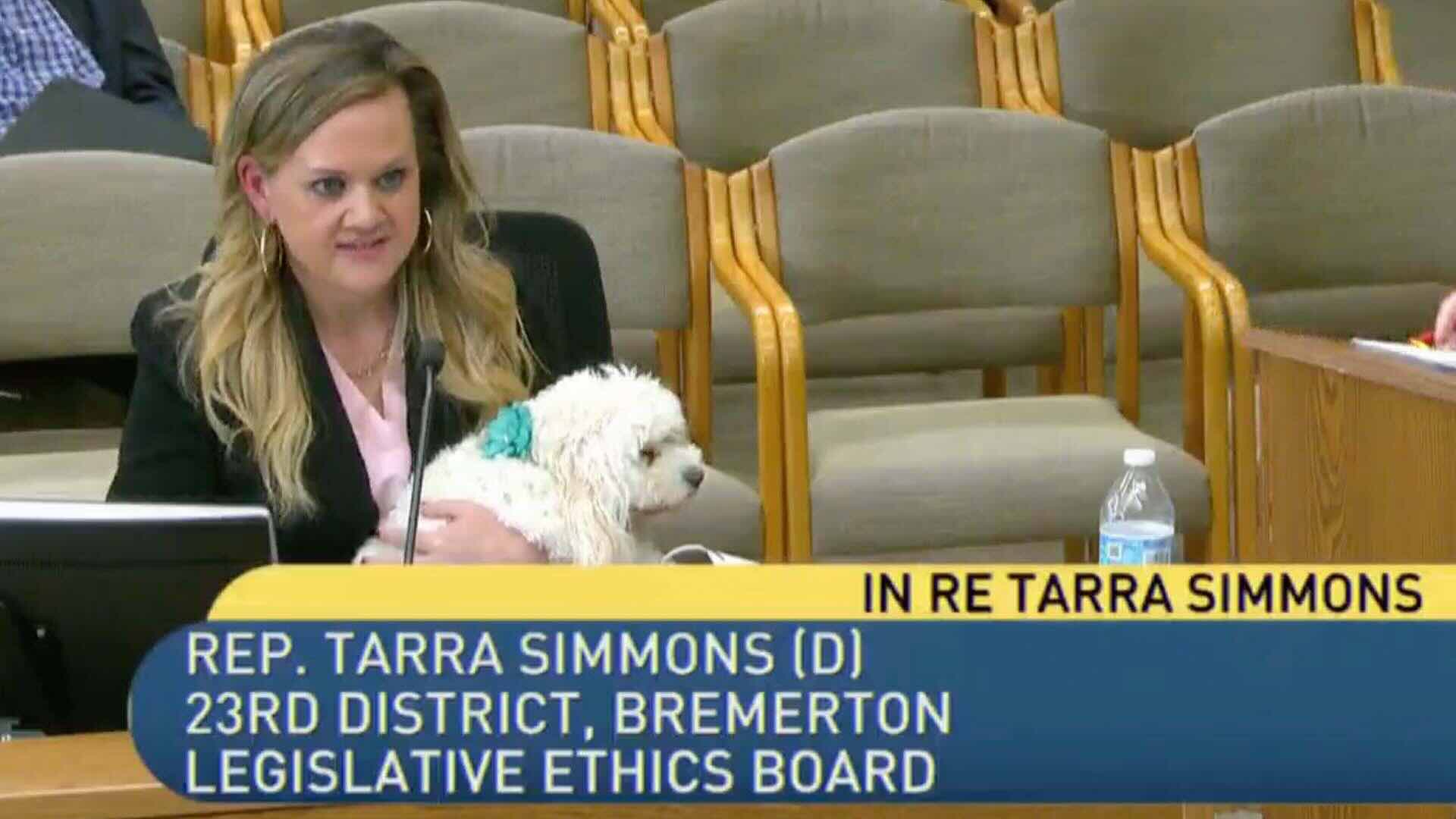
Rep. Tarra Simmons Ethics Board Hearing.
After Two Days of Simmons Ethics Testimony, One Question Still Hung Over the Room: What Did Taxpayers Get?
Rep. Tarra Simmons (D Bremerton, Poulsbo) came to Olympia with one of the most compelling stories in Washington politics. A formerly incarcerated woman who became an attorney and then a state legislator, she built her public life around the idea that society can give people a second chance. Her story raises the question: What happens when activists become lawmakers, when outsiders become insiders and when people who set out to change a system find themselves operating it?
The State Legislative Ethics Board is considering whether Rep. Tarra Simmons violated state ethics laws.
Over two days of testimony on June 8 and 9, Ethics Board members heard evidence involving campaign surplus donations, nonprofit organizations, state-funded projects, employment relationships and allegations that Simmons used her position in ways she should not have.
Simmons denied wrongdoing and repeatedly testified that she worked carefully to separate her legislative duties from her personal life, including employment with the non-profit Equity in Education Coalition (EEC).
I went to the legislature in Olympia to watch an ethics hearing. I discovered a place where activism, nonprofits, government funding, political influence and careers often overlap in ways difficult to untangle.
Mission, Money and Influence.
Simmons described Anthony Powers, founder of the American Equity and Justice Group (AEJG), as a close ally in criminal justice reform. Simmons testified that she introduced Powers to Antoine Coleman, a man she had begun dating, because she believed the two men shared similar experiences and values.
"They both had been incarcerated from a very young age for a very long time. They both were Black. They both were Muslim. They both worked in criminal justice work," Simmons testified.
When Powers said AEJG lacked funding to hire Coleman, Simmons testified offering $10,000 from her surplus campaign funds to help make the hire possible.
Whether that looked like helping a friend or creating a conflict was one of the central disputes underlying the hearing.
Again and again, testimony returned to nonprofit organizations, public funding, contracts, jobs and competing claims about who was responsible for what. Witnesses disagreed on key facts. Former allies challenged one another's accounts. Text messages revealed frustration, distrust and accusations.
The hearing also revealed a gap between ideals and reality.
Simmons frequently spoke about restorative justice, mediation and bringing people together. Yet evidence introduced during the hearing included a text message in which she referred to ethics complainant Kim Gordon, who works at AEJG, as a "wacko."
Simmons acknowledged writing the message and testified that she still wanted dialogue and mediation, despite the conflict.
Loose Public Money
The complaint against Simmons arose, in part, because AEJG was concerned EEC were not delivering the work they were contracted to do.
Others also have concerns with the EEC. According to an August 2025 KUOW article, state auditors discovered the EEC used public funds for first-class flights and an open bar at a resort.
At one point in the hearing, when asked why she was no longer working for the EEC, Simmons replied that there wasn't the money.
That answer lingered because it points to a question that extends far beyond this case. At what point does a movement become an industry itself?
When millions of public dollars flow through organizations like EEC, which claims to be built around advocacy and reform, how much energy remains focused on the mission itself? This leads one to suspect how an organization — invariably seeking “equity” — could just be a conduit to obtain public dollars for the sake of keeping its directors, and other managers, employed.
While the Legislative Ethics Board will decide whether Simmons violated state ethics rules, what stayed with me was a different question. Not whether redemption is possible — Tarra Simmons' life already answers that question. I left wondering whether the hearing exposed something larger: a system where the main players are legislators, friends, lovers, advocates, directors, managers, employees, contractors, grant recipients and political allies — all at the same time.
By the end of the hearing, it was difficult to tell where any mission ended and people's own interests began.
MORE SUMMIT